
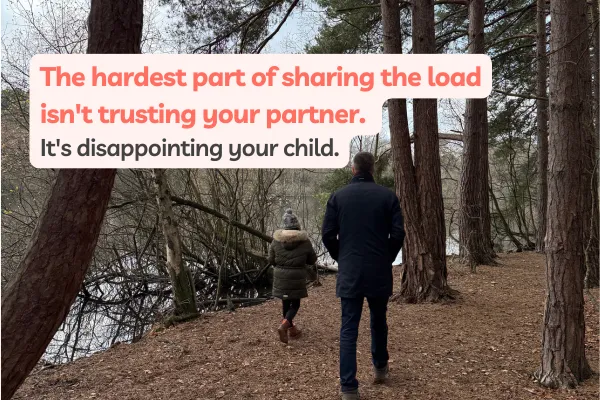
The hardest part of sharing the load isn't trusting your partner. It's disappointing your child.
If you've ever found yourself doing everything at home: the bedtimes, the packed lunches, the mental load of remembering it all and wondered why you can't just let your partner take some of it, this is for you.
It's not because you're a control freak. It's not because he can't do it.
It's because stopping is so much harder than just keeping going. And nobody talks about why.
For years I put my daughter to bed. Every night.
She wanted me. My husband was happy for me to do it. And I told myself that was just how it was.
But the truth is, I could have stopped sooner. My husband was capable. He just hadn't been given the chance because I felt it was my job as her mother to get on and do it so he hadn't had the chance to find his way.
And the reason I kept stepping in wasn't really about him at all.
It was my belief that I should be there for her. Because that's what a good mother does.
The thought of her calling for me and me not being there. The thought of her being unsettled, or sad, or confused about why mummy wasn't doing it tonight. That was the part I couldn't sit with.
So I kept doing it. Every night. Long past the point where it was working for me.
This is what nobody tells you about sharing the load.
We talk a lot about getting our partners to do more. We have the conversations, make the lists, divide up the tasks. And that's all necessary and important.
But there's a step nobody prepares you for. The moment after the conversation, when you actually have to let them do it. When your child asks for you and the answer is "daddy's doing bedtime tonight." When it doesn't go as smoothly as it would have if you'd done it yourself. When you have to sit with the discomfort and listen.
That moment is where most women quietly take it back over.
Not because their partner failed.
Because the mum guilt feels louder than your need to hand it over.
There are two kinds of guilt at play here and we rarely talk about either of them.
The first is the guilt of not doing enough. Of stepping back and wondering if that makes you less devoted, less of a good mother.
The second, and this one is harder, is the guilt of disappointing your child. Of being the reason, even temporarily, that they feel sad because they don't get what they want.
Both of those feelings are real. Both of them make sense. And both of them, if we let them, will keep us carrying far more than our share indefinitely.
Is your guilt telling you something useful or just keeping you stuck?
Not all guilt is the same. Some guilt is a signal worth listening to. Some guilt is just conditioning doing its job, keeping you small, keeping you carrying, keeping you from ever putting anything down.
Here are some questions to help you tell the difference:
Is my child's need genuine right now, or is this a pattern I've created?
There's a difference between your child needing you in a real moment of distress and your child preferring you because that's always how it's been. Preference isn't the same as need.
Would my child be safe, loved and cared for if someone else did this?
If the answer is yes, and usually it is, the guilt isn't about their wellbeing. It's about yours.
Am I doing this because it's genuinely best right now, or because the guilt of not doing it feels unbearable?
If it's the second one, you're not making a choice. You're responding to a feeling.
What would I lose if I stopped? And what might I gain?
This one matters. Because often what we'd lose is the guilt itself, and what we'd gain is time, space and a version of ourselves we've been missing.
None of this means the guilt disappears overnight. But it does mean you get to decide whether to act on it.
Why your child wants you and what that actually means.
If your child calls for you at bedtime, cries when you leave the room, or seems to settle better with you than anyone else, it can feel like proof that you're the one who needs to do it. That you're irreplaceable in those moments. That stepping back would somehow let them down.
But research tells a more interesting story.
A study published in Frontiers in Psychology examining children aged 3 to 6 found that children consistently prefer their mothers in emotionally distressing situations even when they were regularly cared for by multiple caregivers. But here's the part that matters: the amount of time spent with mum didn't significantly predict that preference. What did predict it was parenting style, how attuned, warm and responsive that parent was. (Source: Frontiers in Psychology, 2021)
In other words, your child isn't preferring you because you're their mother. They're preferring you because of how you show up. And that is something their father can learn too.
The gap isn't biological. It's created by the pattern.
Research with over a hundred primary caregiver fathers, including stay-at-home dads, found that fathers don't parent the same way mothers do. When children came to them with emotional hurts, fathers tended to focus on solving the problem rather than sitting with the feeling. At first glance that looks less nurturing. But it isn't. It's a different kind of nurturing. One that builds resilience, independence and emotional self-regulation as children grow. (Source: Andrea Doucet, Do Men Mother?, via The Public Discourse)
A large longitudinal study of Australian families (n=1,884, children aged 6–12) found something even more striking: when mothers were significantly more involved than fathers, fathers displayed less effective parenting and children were less well adjusted overall. The more one parent does, the less the other develops. The gap isn't fixed. It's created by the pattern we keep repeating. (Source: Erasmus University Rotterdam, 2020)
And crucially, research on nurturing fathers shows that when dads are emotionally engaged and given the space to develop their own parenting style, children grow up with higher emotional intelligence, a stronger sense of gender equality, and better overall wellbeing. Mothers and partners are also healthier and happier when fathers are fully involved. (Source: Freethink, Nurturing Dads Raise Emotionally Intelligent Kids)
So do you need to step in?
Sometimes, yes. Genuinely. There will be moments when your child needs you specifically. When they're unwell, frightened, or going through something that calls for the particular comfort only you can give right now. Those moments are real and they matter.
But a child preferring you at bedtime because that's always how it's been? That's not the same thing.
That's a pattern. And patterns can change.
When you step back and let their father find his own way, his own rhythm, his own language for comfort, you're not short-changing your child.
You're giving them two parents who know how to show up for them.
You're modelling what equality looks like.
And you're teaching them, quietly, that they are capable of being comforted, settled and loved by more than one person.
That's not less. That's more.
Here's what I learnt when I finally stopped.
The first few times my husband did bedtime, I felt he hadn't got the parenting knowledge or the skills I had. But in truth it was just new to him. We're different people with different energies. So my daughter wasn't as settled. It took longer.
And I had to sit with my daughter's disappointment. His discomfort. And my own guilt. All at the same time.
But I didn't take it back. I let him keep going.
Over time he found his own way. His own rhythm. His own methods of helping her relax that didn't look exactly like mine and didn't need to.
And what I got back was time. Real time. For me. At the end of the day. I could breathe. I could relax, read, watch TV, catch up on work or I could go out. I didn't have to be home and present for everyone still at 8pm after a busy day.
That's what sharing the load is actually for. Not just the fairness of it, though that matters, but the space it creates for you to exist as a person, not just a mother.
Stepping back from the routine doesn't mean stepping away from your child.
This is the part I want to be really clear about because I there are no hard and fast rules in human relationships.
Letting my husband do bedtime didn't mean I stopped being present for my daughter. It meant I stopped being present by default, and started being present with intention.
On the days she needs me, really needs me, I am there. And I want to be. When she starts back at school and finds it hard, when something has happened with a friend, when I can tell she's carrying something heavy, those are the nights I show up.
And on those nights, we don't just do the usual routine and hope she settles. We talk. I help her process her day. Not by telling her what to do or trying to fix things for her, but by giving her the space to talk about her day so she can better understand it.
Sometimes we write a diary together. What was hard today. What was good. What went well. Getting it out of her head and onto the page so she could close the day properly and actually relax.
That's not something my husband couldn't do. But it's something we tend to do together when it's needed. And because I'm not doing bedtime every single night, I have the energy to be properly present and actually enjoy it.
That's the difference between presence by default and presence by choice.
One exhausts you. The other fills you both up.
Sharing the load doesn't start with your partner being as good as you.
It starts with you tolerating their messy moments and your discomfort while they learn.
It starts with sitting with your child's disappointment and trusting that they will be okay.
It starts with recognising that the guilt you feel when you stop doing everything isn't a sign you're a bad mother. It's a sign of how deeply you've been conditioned to believe that doing it all is what good mothering looks like.
It isn't.
Good mothering includes modelling what equality looks like. It includes showing your child that their needs matter and so do yours. It includes letting their father show up, fully, as their parent too.
This week I'm sharing the real conversations behind all of this: the moment I had to have a word with my husband when the load shifted back onto me, what actually helps versus what just looks like helping, and the guilt that makes it so hard to put things down and walk away.
If any of this is landing for you, I'd love to hear what you're sitting with. Drop a comment over on Instagram because the more honestly we talk about this, the less alone we all feel.
Ready to have these conversations with other women who really get it?
Come and join us in the Rediscover You Women's Circle. Six monthly evenings of open, honest conversation, in person in Wokingham or live on Zoom.
Our first session is all about dropping the guilt that was never yours to carry.
👉 Find out more at rebeccahogan.co.uk/rediscoveryouwomenscircles
I help mothers show up fully at work and at home, so they can fulfil their potential and feel fulfilled in their relationships too. | Author of ME to WE: How to Rediscover Yourself and Truly Thrive in Motherhood | Instagram @rebeccahogan_ | Linked In @rebeccahoganuk Mothers at Work Leadership Coach
References:
Ngoh et al. (2021). Young children's preferences for their mothers: Concurrent predictors and correlates. Education University of Hong Kong
Fuertes et al. (2021). Early Attachment to Mothers and Fathers: Contributions to Preschoolers' Emotional Regulation. Frontiers in Psychology
Doucet, A. Do Men Mother? Research summarised in The Public Discourse
Putnick et al. (2020). Mothers' and Fathers' Quantitative and Qualitative Parenting in Relation to Children's Emotional Adjustment. Erasmus University Rotterdam
Culture, fatherhood and emotional intelligence. Freethink — Nurturing Dads Raise Emotionally Intelligent Kids



© Rebecca Hogan 2026 - All rights reserved
Wokingham, Berkshire